


The power engineering field is changing faster than ever before. Between renewable energy growth, smart grid technology, and digital tools becoming standard practice, electrical engineers need to stay ahead of the curve. Whether you’re just starting your career or looking to move up, these five skills will make you more valuable in the job market and help you tackle the challenges that power systems face today.
Why These Skills Matter Now
Ten years ago, most power engineers focused mainly on traditional grid systems and fossil fuel plants. That’s not the reality anymore. Solar panels are going up on every other roof. Wind farms are spreading across the country. Utilities are installing smart meters by the millions. If you want to stay relevant and competitive, you need to adapt your skill set to match where the industry is headed.
Many of these topics are covered in modern power engineering courses, but staying current requires ongoing learning beyond your formal education. Let’s break down what you should focus on.
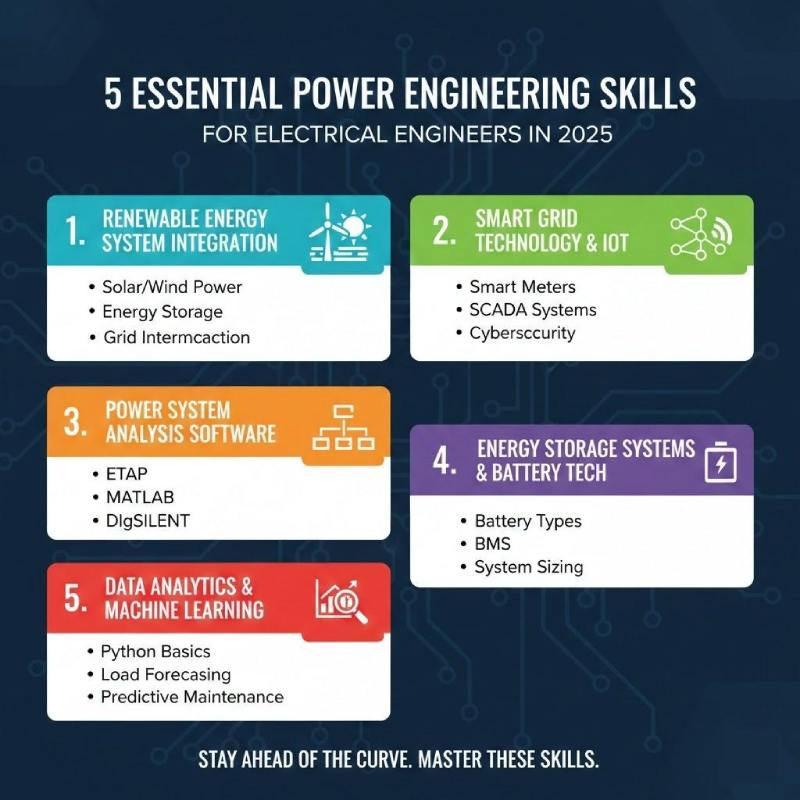
1. Renewable Energy System Integration
Solar and wind power aren’t niche technologies anymore. They’re becoming the backbone of our energy infrastructure. Engineers who understand how to integrate these systems into existing grids are in high demand.
You need to know how photovoltaic systems work, how wind turbines generate power, and most importantly, how to manage the challenges they create. Unlike coal or gas plants that provide steady power, renewable sources fluctuate based on weather conditions. This means you need to understand energy storage, grid stability, and power quality management.
Start by learning the basics of solar panel specifications and wind turbine ratings. Then move into more complex topics like grid interconnection requirements and battery storage systems. Software tools like PVsyst and HOMER can help you practice designing renewable systems without needing access to actual equipment.
2. Smart Grid Technology and IoT Integration
Smart grids are replacing old infrastructure across the country. These systems use sensors, communication networks, and automated controls to manage power distribution more efficiently.
As an engineer, you should understand how smart meters work and how they communicate with utility companies. You also need to know the basics of SCADA systems, which allow operators to monitor and control power networks in real time. Communication protocols like Modbus and DNP3 are the languages these systems speak, so getting familiar with them will set you apart.
Cybersecurity is becoming a huge part of power systems too. Smart grids are connected to the internet, which means they’re vulnerable to attacks. Understanding basic network security principles will make you a more well-rounded engineer.
3. Power System Analysis Software
Gone are the days when engineers relied only on hand calculations and physical testing. Modern power system design happens largely on computers using specialized software.
Programs like ETAP, MATLAB with the Power System Toolbox, and DIgSILENT PowerFactory let you simulate everything from load flow to fault conditions to arc flash hazards. These tools help you design safer, more reliable systems while saving time and money.
You don’t need to master every program out there. Pick one or two that are common in your industry and get really good at them. Most software companies offer trial versions or student licenses that let you practice. Build a portfolio of projects that shows you can use these tools to solve real problems.
4. Energy Storage Systems and Battery Technology
Battery storage is exploding right now. Every new solar installation needs batteries to store excess power. Electric vehicle charging stations are popping up everywhere. Grid-scale storage facilities are being built to balance supply and demand.
Understanding different battery types, how Battery Management Systems work, and how to size storage systems for different applications will make you incredibly valuable. You should know the difference between lithium-ion and flow batteries, understand thermal management challenges, and be able to calculate return on investment for storage projects.
This skill pairs perfectly with renewable energy knowledge. The two technologies work hand in hand to create reliable, clean power systems.
5. Data Analytics and Machine Learning
This might sound like it belongs in a computer science article, but data analytics is becoming essential for power engineers. Modern power systems generate massive amounts of data from sensors and smart meters. Engineers who can analyze this data and use it to make predictions have a major advantage.
You don’t need to become a full-time programmer, but learning Python basics and understanding how machine learning algorithms work will pay off. These skills help with load forecasting, predicting equipment failures, and optimizing system performance.
Start with simple data analysis tasks and gradually work your way up to more complex projects. There are plenty of free online resources that teach these skills specifically for engineering applications.
Getting Started
The best approach is to pick one skill that aligns with your current work or career goals and focus on it for the next few months. Take an online course, work on a personal project, or find ways to apply the skill at your current job. Once you feel confident, move on to the next one.
These skills aren’t just trendy topics that will fade away. They represent fundamental changes in how power systems work. Engineers who master them will find better job opportunities, higher salaries, and more interesting projects throughout their careers.
Also Read: 5 Warning Signs Your CNC Cutting Tools Are Worn Out


Dynamics 365 Migration: Thinks to Know Before a Single Record Moves
Most migration projects do not fail because the tooling is weak. They fail because the team treated the move as…

How to Update Your Resume After a Layoff
It often starts with a fifteen-minute calendar invite called “Quick sync” and an HR person you’ve never met on the…