


If you have spent any time in Indian tech circles lately on LinkedIn, in your company Slack, or at meetups in Bengaluru, Hyderabad, or Pune you have probably heard the phrase “agentic AI” thrown around like it is the next big thing after cloud and DevOps. And honestly? This time the hype is not empty. Agentic AI is genuinely reshaping how software gets built and tested, and for Indian developers and QA engineers, understanding it now is the difference between leading the next wave or scrambling to catch up.
This guide cuts through the buzzwords and explains in plain language exactly what agentic AI means in the context of software testing, why it matters for developers in India specifically, and what you can practically do about it today.
First Things First: What Even Is Agentic AI?
Before we talk about testing, let’s nail down the term itself, because it gets used loosely.
Traditional AI tools like an autocomplete suggestion in your IDE, or a chatbot that answers queries are reactive. You give them input, they produce output. They do not set goals, make sequences of decisions, or adapt their behavior mid-task. They are smart assistants, but they wait for you to steer.
Agentic AI is different. An agentic AI system can:
- Perceive its environment (read code, observe UI changes, analyze logs)
- Set sub-goals on its own to accomplish a larger objective
- Use tools (run a browser, call an API, execute code)
- Adapt its behavior based on what it discovers along the way
- Complete multi-step tasks with minimal or no human input between steps
Think of the difference between a calculator (you press buttons, it responds) and a junior developer you can assign a task to and trust to figure out the steps. That is roughly the difference between traditional AI tools and agentic AI In software testing specifically, an agentic AI system does not just generate test cases when you ask it to. It can understand what an application is supposed to do, explore it autonomously, generate and run tests, analyze failures, self-heal broken scripts, and report results all as a connected workflow rather than isolated steps.
The Old Way vs. The Agentic Way: A Direct Comparison
Here is a simple example that any developer in India working in an Agile team will recognize immediately.
Old way (traditional automation):
- Developer ships a feature
- QA engineer writes test cases manually or with a framework like Selenium
- CI pipeline runs tests
- A UI change breaks 30 scripts
- QA spends two days fixing selectors
- Repeat on next sprint
Agentic AI way:
- Developer ships a feature
- AI agent reads the codebase and user stories, generates test cases, and runs them
- A UI change happens the agent detects it, reasons about the new structure, and updates scripts automatically
- Agent flags genuine failures vs. false positives with explanations
- Developer reviews the summary and merges
The productivity difference is not marginal: teams that have made this shift are reporting dramatically reduced test maintenance cycles and significantly higher test coverage, particularly for regression suites on applications that change daily.
This shift is already underway. The global AI software testing market stood at over $233 billion in 2026 and is projected to grow at a CAGR of over 21% through 2035, driven by demand for autonomous QA and cloud-native testing frameworks. India, as the world’s largest supplier of software engineering talent, sits right at the center of this transformation.
Why Indian Developers Should Pay Attention Right Now
India is not just a market observer here it is a major player. Companies like TCS, Infosys, Wipro, Tech Mahindra, and Cognizant are already deploying AI-driven QA frameworks for global clients. Alongside them, a new generation of Indian QA-focused startups is entering the market with agentic AI as their core thesis.
There are a few India-specific reasons why this matters urgently:
- The talent pressure is real. Indian IT services firms are under consistent pressure to do more with leaner teams. Agentic testing tools directly address this one engineer can oversee automated test suites that would previously require a team of five.
- The skills premium is already forming. The World Quality Report 2025–26 ranks Generative AI as the number one skill for quality engineers globally, ahead of traditional automation expertise. In Indian hiring, this premium is visible: QA engineers with hands-on experience in agentic testing tools are commanding significantly better packages in Pune, Hyderabad, and Bengaluru job markets.
- Global clients expect it. If you are working in a service delivery role for European or American clients, the question is no longer “do you use AI in testing?” but “which agentic testing platform are you using and how is it integrated into your CI/CD pipeline?”
- Startup opportunities. India already has multiple funded startups building agentic AI testing tools. DevAssure, backed by Eximius Ventures, is one example of India-based companies entering the global market with AI-native testing as their primary offering.
How Agentic AI Actually Works in a Testing Context
Let’s go a layer deeper. When people talk about agentic AI in software engineering, they are generally referring to systems built on large language models (LLMs) that have been given tools to act on, not just reason.
In a testing context, the architecture usually looks like this:
The Perception Layer
The agent reads inputs: your codebase, requirements documents, user stories, previous test results, UI screenshots, API specifications. It builds a model of what the application is supposed to do.
The Planning Layer
Based on what it knows about the application, the agent creates a test strategy. Which flows are the highest risk? What edge cases need coverage? Where did similar applications fail historically? This replaces the manual work of a senior QA engineer sitting down to write a test plan.
The Execution Layer
The agent actually runs tests interacting with the real application through a browser or API, not just generating static scripts. It observes what happens and compares it to expected behavior.
The Self-Healing Layer
When the application changes (a button moves, a selector breaks, a flow gets updated), the agent does not just fail to reason about the change and updates its tests accordingly. This is the biggest practical time-saver for teams doing continuous delivery.
The Reporting Layer
Results come back not as raw pass/fail logs, but as contextualized summaries: “These three tests failed because of a regression introduced in commit 4a7f2c. The likely cause is the updated cart validation logic. Suggested priority: high.”
The Four Phases of AI Testing Evolution (And Where We Are Now)
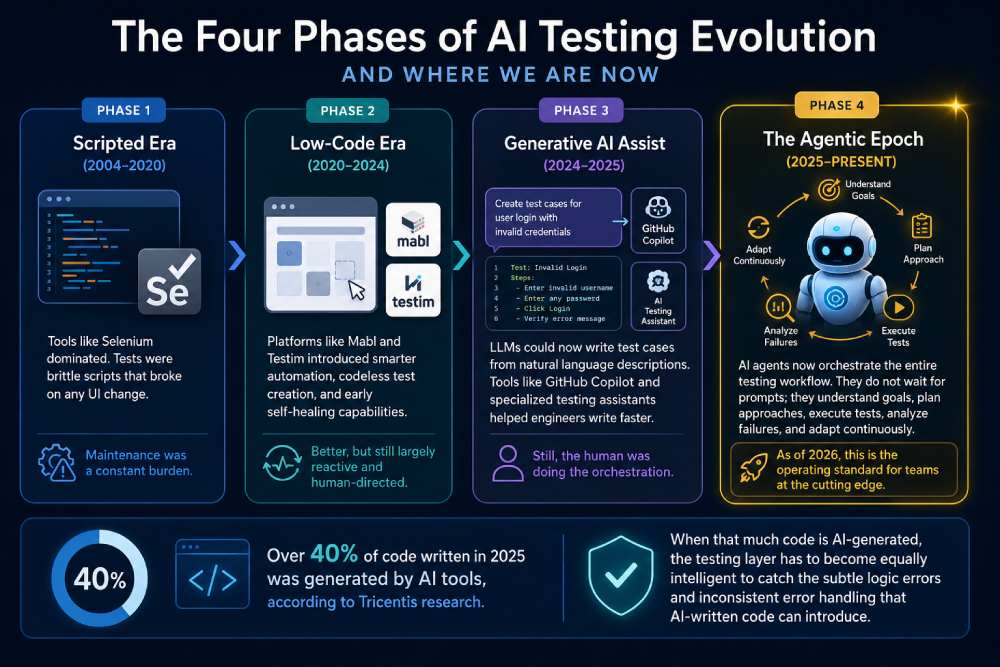
To understand where agentic AI fits, it helps to see it in historical context:
Phase 1. Scripted Era (roughly 2004–2020): Tools like Selenium dominated. Tests were brittle scripts that broke on any UI change. Maintenance was a constant burden.
Phase 2. Low-Code Era (roughly 2020–2024): Platforms like Mabl and Testim introduced smarter automation, codeless test creation, and early self-healing capabilities. Better, but still largely reactive and human-directed.
Phase 3. Generative AI Assist (2024–2025): LLMs could now write test cases from natural language descriptions. Tools like GitHub Copilot and specialized testing assistants helped engineers write faster. Still, the human was doing the orchestration.
Phase 4. The Agentic Epoch (2025–present): AI agents now orchestrate the entire testing workflow. They do not wait for prompts; they understand goals, plan approaches, execute tests, analyze failures, and adapt continuously. As of 2026, this is the operating standard for teams at the cutting edge.
Over 40% of code written in 2025 was generated by AI tools, according to Tricentis research. When that much code is AI-generated, the testing layer has to become equally intelligent to catch the subtle logic errors and inconsistent error handling that AI-written code can introduce.
Key Capabilities That Define Agentic Testing Platforms in 2026
Not all “AI testing” tools are truly agentic. Here is what separates the genuine article from marketing gloss:
Contextual Reasoning: The agent understands the functional role of elements on a page not just their CSS selectors. It knows that “Submit Order” and “Place Order” likely do the same thing, even if they look different.
Autonomous Regeneration: When the UI changes, the agent rewrites its own test steps on the fly, without requiring human intervention.
Goal-Oriented Test Creation: You describe what the application should do, and the agent determines how to test it. No scripting required.
Multi-Agent Orchestration: Advanced platforms deploy multiple specialized agents in parallel, one focusing on security, one on performance, one on functional flows coordinating their findings into a unified quality picture.
In-Workflow Feedback: Results come back as videos, logs, and traces delivered directly into the developer’s workflow in their IDE, Slack channel, or Jira board not as a separate report nobody reads.
What This Means for QA Roles in India: Honest Assessment
Let’s address the question everyone is quietly asking: will agentic AI replace QA engineers?
The honest answer is nuanced. Repetitive, script-based QA work regression test maintenance, basic smoke testing, selector upkeep is already being automated away. This is simply true, and pretending otherwise is not helpful to anyone building a career in this space.
But the role is not disappearing. It is evolving. Here is the shift:
Being replaced (or heavily automated):
- Writing and maintaining regression scripts
- Basic test case authoring from user stories
- Routine smoke testing before releases
Growing in value:
- Designing quality strategies and defining what “good” means for an AI-generated product
- Evaluating AI-generated test results for accuracy and relevance
- Exploratory testing for edge cases agents miss
- Building and governing the agentic testing infrastructure itself
- Communicating quality risks to business stakeholders
The World Quality Report 2025–26 found that verbal and written communication ranked fifth among the most important QA skills globally reinforcing that human judgment, interpretation, and cross-functional collaboration are becoming core QA competencies, not optional extras.
For Indian QA engineers specifically, the message is clear: invest in understanding how agentic AI testing platforms work, not just how to use them. Engineers who can evaluate, configure, and govern these systems will be extremely valuable. Engineers who are only skilled in writing Selenium scripts will find themselves displaced.
Practical Steps for Indian Developers Getting Started
You do not need to overhaul your entire testing practice overnight. Here is a pragmatic progression:
Step 1: Get familiar with at least one AI-native testing platform. Tools like Testsigma, ACCELQ, Mabl, Testim, and others offer free trials. Spend a few hours understanding how they differ from traditional Selenium-based frameworks.
Step 2: Learn to evaluate agentic behavior. When an AI agent makes a testing decision choosing which tests to run, or how to interpret a failure can you understand why it made that choice? This meta-skill is more valuable than knowing the syntax of any specific tool.
Step 3: Study test architecture. How do you structure a test suite so an AI agent can work with it effectively? How do you write user stories that give an agent enough context to generate good tests? These are design decisions that matter.
Step 4: Understand CI/CD integration. Agentic testing only delivers value when it is woven into your delivery pipeline. Understanding how to integrate testing agents into GitHub Actions, Jenkins, or GitLab CI is an immediately practical skill.
Step 5: Explore how platforms are approaching this space globally. For Indian developers looking to understand how platforms are thinking about AI-driven quality engineering for Indian markets specifically, it is worth seeing how global testing tools are adapting their workflows for the scale and diversity of Indian software delivery contexts.
Agentic AI and Test Data: The Often-Overlooked Challenge
One area where Indian developers frequently hit friction when adopting AI testing tools is test data management. Agentic AI systems need good input to produce good output and poor test data remains one of the most common reasons AI-driven testing fails to deliver on its promise.
A few things to get right:
Data diversity matters. Indian applications often need to handle multiple languages, regional date formats, GST-specific business logic, and varied payment gateway behaviors. Test data that only covers English-language, US-centric scenarios will produce false confidence in your test coverage.
Synthetic data generation is a skill. Modern agentic platforms can generate synthetic test data, but you need to configure the parameters well. Understanding what “realistic” means for your specific user base is a human judgment call that the AI cannot make for you.
Privacy compliance is non-negotiable. The Digital Personal Data Protection Act (DPDPA) in India, alongside global regulations like GDPR, creates real constraints on using production data in testing environments. Agentic testing platforms that include built-in data masking and anonymization capabilities are not a luxury; they are a compliance requirement.
Performance and Security: Two Areas Where Agentic AI Is Proving Its Value
Beyond functional testing, two areas deserve specific attention for Indian development teams:
Performance Testing at Scale
Indian applications particularly in fintech, edtech, and e-commerce face enormous traffic spikes around events like IPO openings, exam result announcements, or sale days. Traditional performance testing required significant manual setup to simulate these scenarios. Agentic AI tools can now model realistic user loads based on historical behavior patterns, run stress tests autonomously, and identify bottlenecks without teams needing to script every scenario manually.
Security Testing
India’s cybersecurity landscape is evolving rapidly, with application layer attacks increasing significantly year on year. AI tools that analyze application behavior for security vulnerabilities integrated directly into the development pipeline rather than treated as a separate audit phase are becoming standard at mature organizations.
Developers working with platforms designed around autonomous AI testing workflows increasingly find that security validation is built into the same agent that handles functional and regression testing, rather than sitting in a separate silo.
Common Mistakes When Adopting Agentic AI Testing
Based on how teams across India and globally have stumbled with AI testing adoption, here are the most common pitfalls:
Treating it as a drop-in replacement for Selenium. Agentic AI testing is a different paradigm, not just a smarter Selenium. Teams that try to replicate their existing test architecture with an AI tool often miss the fundamental workflow changes that make agentic testing powerful.
Expecting zero maintenance. Self-healing tests reduce maintenance dramatically, but they do not eliminate it entirely. An agent that rewrites a test when a UI changes needs to have that rewrite reviewed periodically to ensure the updated test is still testing the right thing.
Neglecting observability. When an AI agent makes an autonomous decision about how to test something, you need to be able to see its reasoning. Platforms that offer good logging and explanation features are significantly easier to trust and govern than black-box systems.
Moving too fast on business-critical flows. Start with lower-risk test suites. Build confidence in how the agent behaves before putting your payment flow or authentication logic entirely in the hands of autonomous testing.
Skipping team training. As Nibs Mishra from Nationwide noted at the Tricentis Transform 2025 conference: “Don’t throw tools at the problem, bring your workforce with you.” Technical adoption without upskilling the people who will govern the system is a common failure mode.
The India Opportunity: Beyond Services Into Products
There is a larger conversation worth having here. India has historically been the world’s destination for software testing services. But agentic AI is opening a window to become a major contributor to testing products and platforms.
Indian engineers understand the complexity of software delivery at scale, multi-lingual requirements, diverse device ecosystems, regional compliance variations, high-volume distributed architectures. These are precisely the challenges that next-generation testing platforms need to solve. Several India-based startups are already positioning themselves in the global AI testing tool market, and the engineering talent to build world-class platforms clearly exists.
For individual engineers and for companies, the question to sit with is: are we only building skill in using these tools, or are we building the capability to shape how they work?
What to Look for in an Agentic Testing Platform in 2026
If your team is evaluating tools, here is a checklist of what genuinely matters in 2026:
- LLM-based contextual reasoning, not just pattern matching
- Self-healing test maintenance that handles real UI complexity, not just simple selector changes
- Natural language test creation that non-technical stakeholders can use
- CI/CD native integration with your existing pipeline
- Strong observability you can see why the agent made each decision
- Multi-environment coverage web, mobile, API, and desktop from a single platform
- Security and data privacy controls that meet Indian and global regulatory requirements
- Genuine support and documentation, not just sales promises
A Word on Keeping the Human in the Loop
One of the most important principles in responsible agentic AI adoption in testing or anywhere else is maintaining meaningful human oversight. This is not about distrust of technology. It is about understanding where human judgment genuinely adds value and building workflows that preserve it.
In testing specifically, this means: define clear boundaries for what the agent decides autonomously and what requires human sign-off. Treat AI-generated test coverage metrics with appropriate skepticism until you understand what the agent is actually testing. Build in regular reviews of agent behavior, not just automated dashboards.
The teams doing this best in 2026 are not those who have handed testing entirely over to AI agents, and not those who are still doing everything manually. They are the teams who have made deliberate, well-governed decisions about where automation earns trust and where human judgment remains essential.
Quick Glossary for Developers New to Agentic AI Testing
Agent: An AI system that can perceive its environment, set sub-goals, use tools, and take sequences of actions autonomously.
Self-healing tests: Test scripts that automatically update themselves when the application’s UI or behavior changes, without human intervention.
LLM (Large Language Model): The type of AI model (like those powering ChatGPT, Claude, or Gemini) that powers most agentic testing platforms’ reasoning capabilities.
Agentic orchestration: Coordinating multiple AI agents working in parallel on different aspects of a testing task (security, performance, functionality).
Synthetic test data: Test data generated algorithmically to mimic realistic user inputs and scenarios, used when production data cannot be used directly.
CI/CD (Continuous Integration/Continuous Delivery): The practice of automatically building, testing, and deploying software as developers push code changes.
Self-directed testing: A testing system that can set its own testing agenda based on application behavior, risk signals, and historical defect patterns without a human prescribing every test case.
Looking Ahead: What Comes After Agentic Testing?
The trajectory from scripted tests to low-code to AI-assisted to agentic is clear. What comes next is already visible at the research frontier:
Multi-agent orchestration at scale: Networks of specialized agents security, performance, accessibility, functional working in concert, sharing observations, and producing a unified quality signal.
Goal-oriented testing: Rather than defining what to test, you define what outcomes matter, and the agent figures out how to test for them.
Production-integrated quality: Testing that does not stop at deployment but continues to learn from production behavior, feeding insights back into the test strategy in real time.
AI-validated AI: As AI-generated code becomes the majority of production code, specialized agents designed to test for the specific failure patterns of AI-written code will become standard infrastructure.
For Indian developers building careers and for Indian companies building products, the opportunity window is right now. The paradigm has shifted. The tools exist. The market rewards those who move with competence rather than waiting for the destination to be obvious.
Final Thoughts
Agentic AI in software testing is not a future concept to prepare for. It is a present reality that early adopters are already leveraging to ship faster, catch bugs earlier, and operate with leaner QA teams. For Indian developers whether you are at a global IT services firm, a product startup, or building your own engineering practice, understanding this technology at a level deeper than the marketing pitch is now a professional necessity.
The core insight to take away: agentic testing tools do not replace the need for quality thinking. They replace the need for repetitive quality execution. Engineers who invest in developing the quality of the strategy, the governance, the judgment will find agentic AI to be a powerful multiplier of their value. Those who rely entirely on the execution skills they have today will find themselves on the wrong side of the next major shift in the industry.
The tools are here. The demand is real. The only question is how quickly you choose to engage with it.


Wake Up to Waves: Premium Stays Along Mumbai’s Famous Shoreline
Mumbai’s coastline blends the calm of the sea with the energy of the city, creating a refreshing and dynamic travel…

Essential Cyber Defence Strategies for Modern Decentralised Workplaces
The shift towards remote work has fundamentally transformed the Australian business landscape. Today, more than half of the workforce operates…