

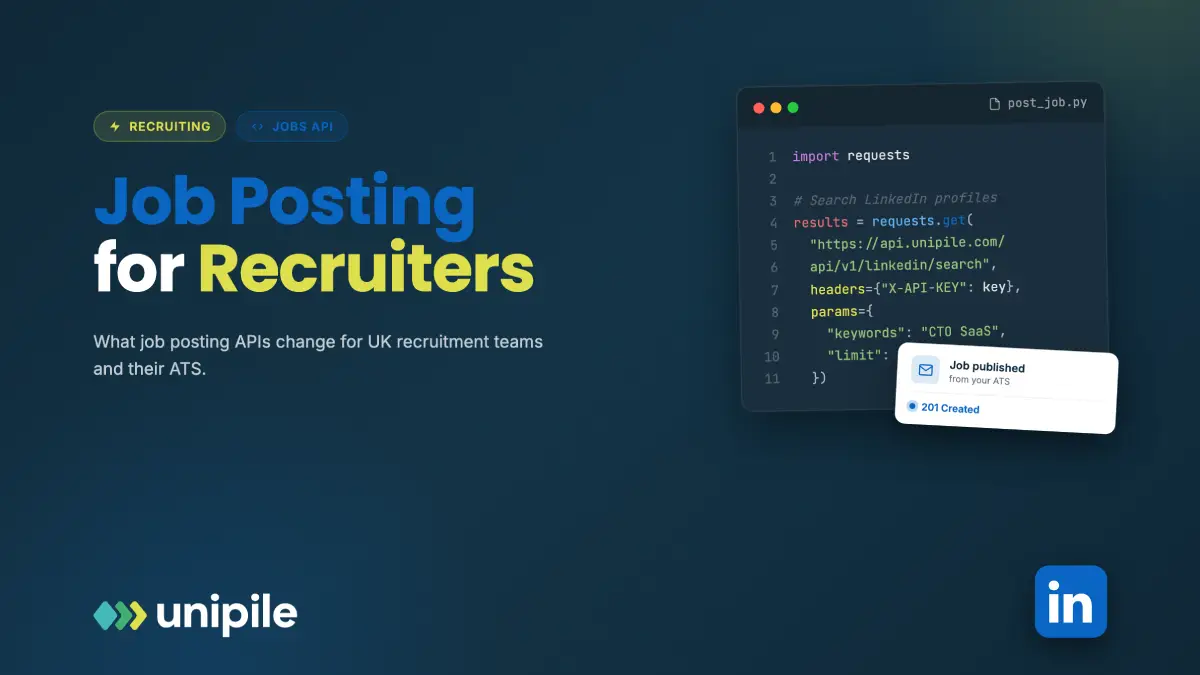
Ask any in-house recruiter or agency consultant in the UK where their week goes, and a surprising share of the answer is admin: retyping adverts, chasing listings that should have closed, downloading CVs from one system to upload them into another. Job posting through an API will not fix hiring on its own, but it removes a lot of that friction. Here is what actually changes for a recruitment team when their applicant tracking system can publish to LinkedIn directly, and what to ask a vendor before signing.
Introduction
For most recruitment teams, LinkedIn is not optional: it is where many candidates look first and where hiring managers expect their roles to appear. Yet the way adverts get there is often surprisingly manual. A recruiter writes the role in the applicant tracking system (ATS), then copies it, field by field, into LinkedIn. A linkedin jobs api changes that routine by letting the ATS create, publish, update and close the advert itself, under the recruiter’s own LinkedIn profile, while the recruiter stays in the tool they already use all day. This piece looks at what that means in practice, from the recruiter’s chair rather than the developer’s.
A typical week, before integration
Picture an in-house talent team at a mid-sized UK firm, or a small agency handling roles for several clients. On Monday, three new vacancies are approved. Each is drafted in the ATS, then rewritten into LinkedIn’s posting form. On Wednesday, a hiring manager changes the salary band and the location from London to hybrid; the ATS is updated, the LinkedIn advert is not, because someone was in interviews. On Friday, one role is filled, yet applications keep arriving for another fortnight because nobody remembered to close the listing.
None of this is dramatic. It is simply the kind of small, repeated friction that eats hours and, more importantly, gives candidates a poor experience: applying for a job that no longer exists is one of the quickest ways to damage an employer brand.
What changes when the ATS publishes for you
With a job posting API wired into the ATS, the advert has one source of truth. The recruiter creates the role once, with its title, description, location, workplace type and company, and the system publishes it to LinkedIn. Because the integration acts on behalf of the authenticated user, the advert appears under that recruiter’s LinkedIn profile, exactly as if they had posted it by hand.
The bigger change is what happens afterwards. Edits made in the ATS, a new salary band, a revised description, an extended closing date, can be pushed to the live listing. When the role is filled or put on hold, the ATS closes it on LinkedIn too. For teams juggling dozens of open roles, that single change, adverts that close when the job closes, is often the one people notice first.
There is also a less visible step. LinkedIn occasionally asks for an extra verification before a job goes live, and the Unipile API includes a specific step for resolving a job publishing checkpoint. A good ATS surfaces that to the recruiter clearly rather than leaving the advert stuck in draft.
Applicants come back to the same place
Posting is only half the job. The other half is the people who apply. Through the same integration, the ATS can list the applicants to a posting, open a specific application and download the candidate’s CV. That means applications flow into the pipeline the team already manages, with its stages, notes and interview scheduling, instead of sitting in a separate inbox that someone has to check and copy across.
For agencies, this matters even more. A consultant working across several clients can see every applicant for every live role in one view, rather than logging into a different place for each.
What it does not change
It is worth being clear about the limits, because vendors are not always.
- Judgement stays human. An API publishes adverts and retrieves applications; it does not decide who gets shortlisted.
- LinkedIn’s rules still apply. Posting limits, publishing checks and account restrictions are set by LinkedIn. Unipile relays those signals so the ATS can pace itself, and how many roles a team posts, and how often, remains the customer’s decision, within LinkedIn’s current terms.
- It works through people’s own accounts. The integration acts on behalf of the recruiter who connected their LinkedIn account, within what that account can already do. It is not a back door to anything else.
Unipile operates as an independent technical intermediary between the ATS and LinkedIn, and it is not affiliated with, endorsed by, or sponsored by LinkedIn.
Questions to ask your ATS vendor
If your current or prospective ATS claims LinkedIn job posting, a few questions separate a real integration from a marketing line:
- Does the advert publish under our recruiters’ own LinkedIn profiles, and how do they connect their accounts?
- When we edit or close a role in the ATS, does the LinkedIn listing update automatically?
- Do applicants and their CVs come back into the ATS, or only a link?
- How are LinkedIn’s limits and publishing checks shown to recruiters when they occur?
- Where is candidate data stored, for how long, and how do you handle deletion requests under UK GDPR?
- Which security certifications does your integration partner hold? (Unipile, for example, is SOC 2 Type II certified and GDPR compliant.)
The answers will tell you quickly whether the feature saves your team time or simply moves the copy and paste somewhere else.
Data protection is part of the brief
UK employers handle candidate data under the UK GDPR and the Data Protection Act 2018, and CVs are among the most sensitive documents a business holds. Pulling applications into the ATS is a good thing, because it centralises that data in one system with proper access controls, but only if retention rules come with it. Agree how long unsuccessful applications are kept, make sure deletions in the ATS really delete, and check that candidates’ details are only used for the recruitment purpose they applied for.
Done well, a job posting integration is not a flashy feature. It is an advert that is right on the day it goes live, still right when the brief changes, and gone when the role is filled, with every applicant already waiting in the system your team trusts.
Fewer Tabs, Fresher Adverts: What Job Posting APIs Mean for UK Recruitment Teams

Fewer Tabs, Fresher Adverts: What Job Posting APIs Mean for UK Recruitment Teams
Ask any in-house recruiter or agency consultant in the UK where their week goes, and a surprising share of the…

How AI Image Generation Is Changing the Way We Create Visual Content
Creating high-quality images used to require a combination of design skills, expensive software, photography equipment, and plenty of time. Today,…