

Email marketing is one of those channels that keeps proving skeptics wrong.
The types of email campaigns you run determine whether your list becomes a revenue engine or a collection of people who quietly unsubscribe.
Done right, email marketing campaigns deliver more ROI than most paid channels. Done wrong, they burn your list and your sender reputation at the same time.
This guide breaks down the campaigns that actually work, why they work, and when to use them. If you partner with a Content Marketing Agency in India that handles email as part of a broader content strategy, you already know how much sequencing and messaging quality matter. For everyone else, this is where to start.
Welcome Campaigns: The First Impression That Sets the Tone
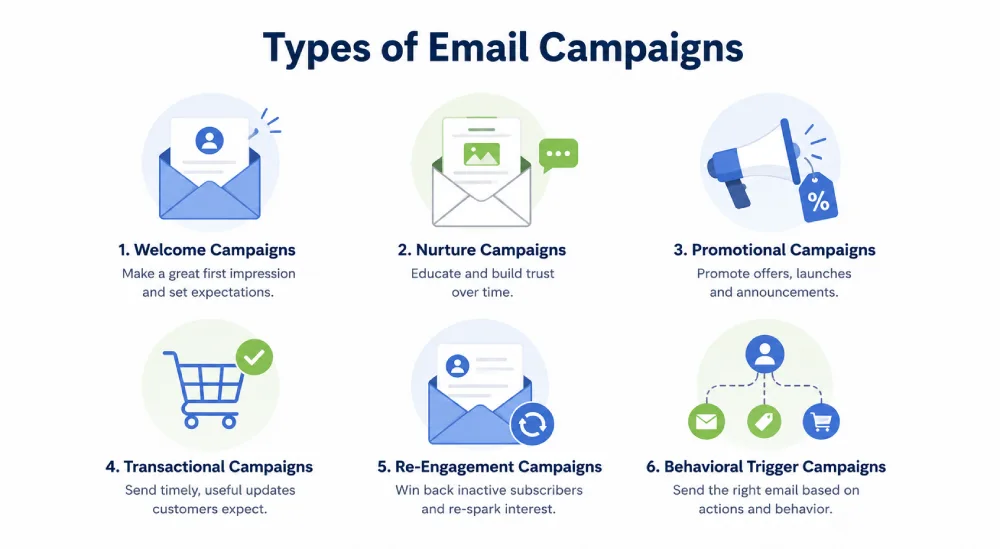
A welcome email is not optional. It has the highest open rate of any email you will ever send. A subscriber just raised their hand. That attention window closes fast.
A good welcome sequence does three things:
- Confirms what the subscriber signed up for
- Delivers immediate value (a resource, a discount, a useful tip)
- Sets expectations for what comes next
Most brands send one generic “thanks for subscribing” email and call it done. That is a missed opportunity. A three-to-five email welcome sequence, spaced over one to two weeks, consistently outperforms a single message in both engagement and early conversion.
Quick summary: Welcome campaigns capture peak subscriber attention. A short sequence of three to five emails, spaced over one to two weeks, builds familiarity and drives early action far better than a single “thank you” email.
Nurture Campaigns: Moving Leads Down the Funnel
Not every lead is ready to buy on day one. Nurture campaigns exist for exactly that gap. They deliver consistent, relevant content over time to keep your brand top of mind until the prospect is ready to act.
The best email marketing examples in the nurture category share one trait: they educate without pushing. Each email answers a question the prospect is likely asking at that stage.
How to Structure a Nurture Sequence
A typical B2B nurture sequence covers four stages:
- Awareness. Address the problem the prospect is facing. No product talk yet.
- Consideration. Introduce your category of solution. Case studies and comparison content work well here.
- Decision. Bring in product-specific benefits, social proof, and a clear offer.
- Re-engagement. For contacts who went cold, a separate branch pulls them back before they are lost.
The mistake most teams make is treating nurture as a drip of their best blog posts. Nurture email should be purpose-built for conversion, not repurposed content with a “read more” link.
Promotional Campaigns: When You Have Something Worth Saying
Promotional emails get a bad reputation because most of them are lazy. A discount banner, a product shot, and a “shop now” button is not a campaign. It is noise.
The examples of email marketing campaigns that cut through in a crowded inbox share a few things. They lead with a reason to care, not a reason to buy. They are timed to something real (a launch, a season, a milestone). And they make the offer feel limited without manufacturing fake urgency.
Best email marketing campaigns in the promotional category often work in a series of three:
- Email 1: Announce the offer. Build excitement.
- Email 2: Remind and add social proof.
- Email 3: Last chance. Clear deadline.
That structure alone will lift conversion rates compared to sending a single promotional blast.
Note: Promotional emails perform better when they follow a warm-up period of value-first content. Sending straight to your full list with no context is a reliable way to spike unsubscribes.
Transactional Campaigns: The Emails People Actually Want
Order confirmations. Shipping updates. Password resets. These are transactional emails, and they have open rates that most marketers would trade their entire promotional list for.
Because people expect them and want them, transactional emails are the most underused real estate in email marketing.
Smart marketers do not let them go to waste. An order confirmation can upsell a complementary product. A shipping update can introduce a loyalty program. A receipt can ask for a review at exactly the right moment.
None of this requires aggressive sales copy. It requires paying attention to what the subscriber just did and responding in a way that is genuinely useful.
Re-Engagement Campaigns: Saving the Subscribers Who Drifted
Every list has a segment of subscribers who stopped opening. Most email marketing options ignore them until list hygiene becomes an emergency.
Re-engagement campaigns target these cold subscribers before they damage your deliverability. A good sequence is short and direct: three emails over two weeks, with the final one making it clear that removal is coming if there is no response.
That honesty converts a portion of cold subscribers back into active ones. The rest should be removed. A smaller, engaged list always outperforms a large, dead one.
What to Write in a Re-Engagement Email
Lead with curiosity or honesty. “We noticed you have been quiet” works. “We miss you” works. What does not work is a discount with no context, which trains subscribers to go cold intentionally and wait for the offer.
Behavioral Trigger Campaigns: The Most Underused Email Marketing Campaigns
Behavioral triggers fire based on what a subscriber does, or does not do. Someone browses a product page three times and does not buy. Someone downloads a whitepaper and never books a demo. And, someone starts onboarding and drops off at step two.
These are signals. The right email at the right moment converts them into action.
Types of email campaigns built on behavioral triggers include:
- Abandoned cart emails (for e-commerce)
- Browse abandonment emails
- Post-download follow-ups
- Milestone emails (user completes a key action in your product)
- Inactivity alerts (in SaaS or subscription products)
The reason behavioral emails outperform broadcast campaigns is simple. They are relevant to what the person just did. Relevance is the only thing that makes email marketing feel personal at scale.
Must Read: Behavioral trigger campaigns consistently generate two to five times the revenue per email compared to standard broadcasts. The setup takes longer, but the return compounds over time without additional send volume.
FAQs
What are the most common types of email campaigns? The most common types include welcome sequences, promotional campaigns, nurture drips, transactional emails, re-engagement campaigns, and behavioral trigger emails. Each serves a different stage of the customer journey and should be used in combination.
What makes an email marketing campaign successful? Relevance, timing, and a clear action. Successful campaigns deliver the right message to the right segment at a moment when the subscriber is most likely to act. Generic blasts to full lists rarely perform well.
How often should businesses send marketing emails? Frequency depends on your audience and content quality. For most B2B businesses, two to four emails per month per segment is a reasonable starting point. The better question is whether each email earns attention, not how many you can send.
What are examples of email marketing campaigns that drive conversions? Behavioral trigger sequences like abandoned cart and post-download follow-ups consistently top conversion benchmarks. Three-part promotional sequences with a deadline also outperform single sends. Welcome sequences with early value delivery set up long-term conversion rates across the list.
Also Read: Mobile App Development Trends Winning the Houston Tech Market in 2026 (TekRevol Insights)


Adam Back Denies Being Satoshi Nakamoto
A British cryptographer has supposedly been outed as the creator of Bitcoin. According to the New York Times, Adam Back…

The Tech-Savvy Traveler’s Guide to Urban Adventures
Your smartphone has become the ultimate travel buddy for exploring a new city. It’s your map, your translator, your camera,…