

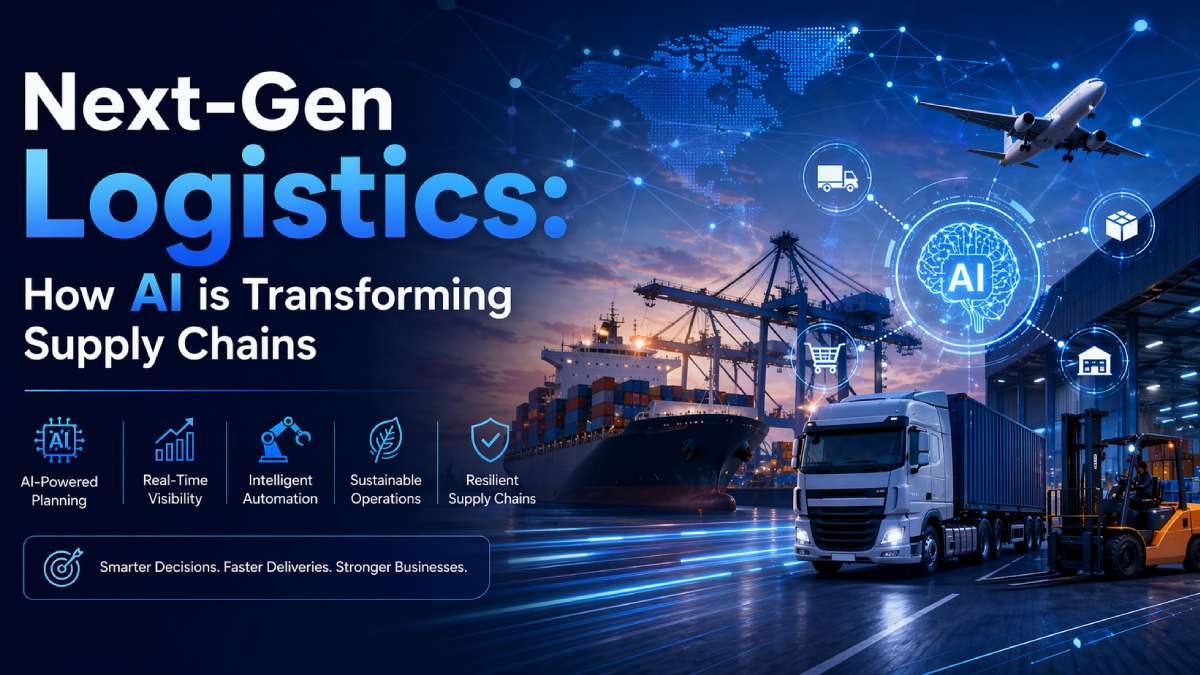
From predictive demand sensing to autonomous warehouses, AI in logistics is no longer a future concept, it is the operating model of high-performing supply chains in 2026.
The new era of logistics: why AI matters now
Modern supply chains are more complex than ever. The movement of a single consumer order can involve a dozen or more countries, dozens of suppliers, and different means of transportation before it reaches the door of a person. A broken link in the chain – a port shutdown, a weather condition, spike in demand – causes ripple that is sudden and expensive.
Traditional supply chain management was designed for a more predictable world. Spreadsheets, monthly reviews, and making decisions on the fly cannot keep up with the current volatility. That is exactly why AI in the supply chains operations shifted to non-experimental investment to the infrastructure of the core business.
The scale of the shift
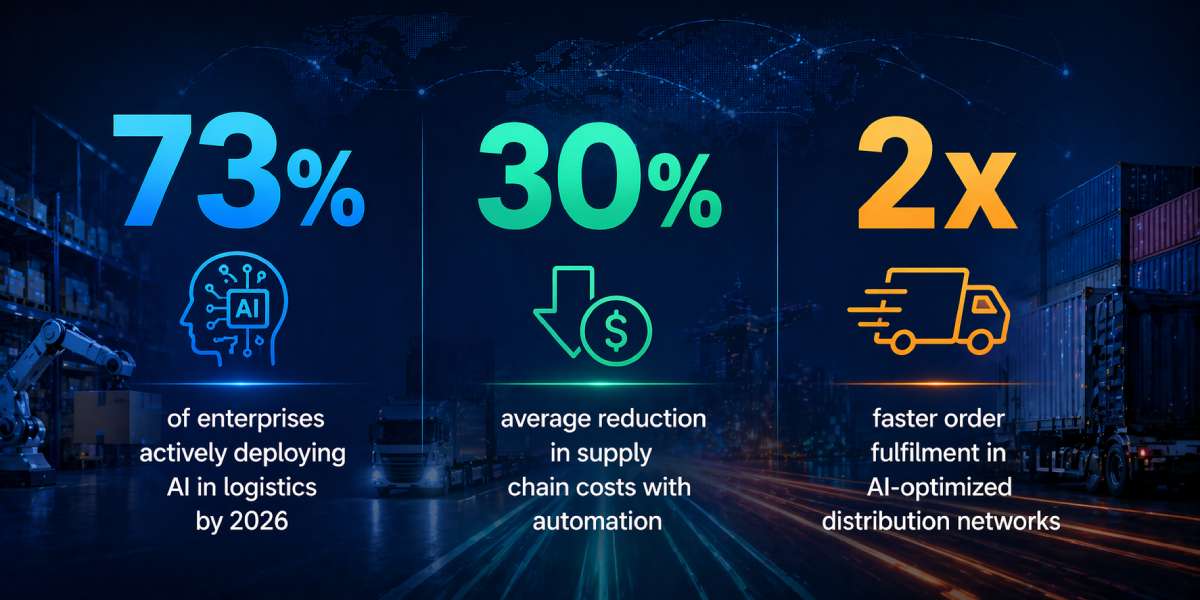
The question to business leaders is not whether to adopt next-gen logistics, but how they can establish the base in the shortest time possible to be effective.
Core AI supply chain solutions are reshaping operations
Predictive demand and inventory intelligence
Demand forecasting is one of the most important uses of AI in logistics. Conventional approaches use the historical averages and fixed models. AI-driven systems feed on real-time signals, like weather conditions, social media sentiment, macroeconomic indicators and point-of-sale data to predict demand in a much more precise way. This would allow smarter inventory placement, reduction in stockouts and tremendous waste through overstocking.
Autonomous and intelligent warehousing
Within distribution centers, supply chain automation is changing the way goods are received, stored, picked and packed. Robotic pickers, computer-vision-based quality inspection, and AI-controlled slotting algorithms can now be used in addition to human crews to improve throughput and cut mistakes. The outcome is a warehouse, which learns and gets better over time instead of a warehouse, which merely follows a set of predefined workflows.
Real-time route and carrier optimization
Last-mile delivery is also being redefined through the use of Logistics automation services. To produce the best possible routes in real-time, AI models take into account hundreds of variables at once: traffic, fuel prices, delivery slot, availability of drivers, capacity of vehicles, and so on. As the conditions vary during the delivery process, the system changes dynamically to minimise the cost and maximise on-time performance.
Supply chain risk intelligence
AI is good at identifying patterns in large and noisy data sets—and supply chain risk is precisely that. Advanced digital supply chain platforms also incorporate risk monitoring engines, which search the financial health of suppliers, geopolitical news, port congestion data, and climate models as early warnings before disruptions turn into a crisis. The companies that employ such tools react quicker, seek alternatives actively, and prevent the sort of expensive surprises that are featured in the news.
Firms that use AI supply chain solutions indicate up to a 50% increase in forecast accuracy and a 20.3% decrease in logistics costs, not in years, but in the first 12 months of implementation.
Benefits across the supply chain lifecycle
End-to-end visibility
The most radical advantage of AI in supply chain management, perhaps, is the transition to partial and delayed information to real-time, end-to-end visibility. All shipments, all suppliers, all warehouses all linked and seen through one pane of glass. Making decisions is no longer based on yesterday’s information; it is based on what is taking place now.
Cost efficiency at scale
AI-integrated logistics software development services enable companies to discover inefficiency that cannot be discerned by humans at scale: unnecessary freight lanes, inefficient carrier combinations, inventory dragging excessively through costly storage facilities, and procurement cycles that fail to realize volume discounts. Every insight is directly converted to savings.
Resilience and business continuity
One of the biggest losses in the global economies is hundreds of billions of dollars per year because of supply chain disruption. The AI-driven resilience tools can also assist the organizations to simulate the disruption scenarios, test contingency plans, and maintain the alternative supply chains, as a result of which, in case of failure, recovery will take hours rather than weeks.
Sustainability and compliance
Next-gen logistics is also green logistics. AI optimization minimizes unneeded mileage, optimizes shipments more efficiently, and offers the emissions data that businesses require to comply with regulations and report on ESG. In the case of companies that have net-zero goals, digital supply chain services are becoming the cornerstone of their sustainability approach.
Implementing AI in logistics: the practical roadmap
Where to begin
The AI applications in logistics can hardly be considered big-bang changes. The most likely option is small: identify two or three points of high impact on pain, demand forecasting accuracy, carrier cost overruns, or warehouse throughput, and build early AI applications around those areas of focus.
1. Data foundation first
Artificial intelligence is as good as the data it gets. The precondition of any supply chain automation initiative is auditing data quality and standardization of feeds of ERP, WMS, TMS, and supplier systems.
2. Choose platforms that integrate
The development of purpose-built logistics software that is developed should be compatible with the existing systems instead of being a complete replacement. API-first architectures speed up time to value.
3. Build for change management
It is not technology that transforms supply chains, but people. Training, process redesign, and the establishment of clear accountability structures are as significant as the AI itself.
4. Measure, iterate, scale
Pre-deployment KPIs clear outlines: forecast predictability, timely delivery, and cost per unit shipped. Measure data on these metrics to optimize models and construct the internal argument to expand AI throughout the supply chain.
Common pitfalls to avoid
- Taking AI as a one-time application rather than a continually learning system.
- Underestimating data quality as the largest obstacle to AI performance.
- Using the tools that address individual issues instead of linking an entire supply chain.
- Not engaging operation teams early enough—the problems with adoption are cultural as opposed to technical.
Future trends and the road ahead
Autonomous supply chains
The rational end of supply chain automation services is a more or less self-organising supply chain one in which AI not only reveals but also makes decisions independently within specified guardrails. Independent procurement agents, automatic replenishment of inventory, and independently negotiated carrier contracts have already been in pilot testing at major companies. These capabilities will become mainstream by 2028.
Generative AI in logistics planning
Generative AI is providing brand new opportunities to the logistics strategies. Supply chain planners are now able to query large language models trained on their own operational data to simulate situations, create contingency plans, and write supplier communications all in natural language. This reduces the cost of advanced planning, and teams of all sizes can now afford an enterprise grade analysis.
Hyperconnected supplier ecosystems
Next-gen digital supply chain services are not only internal optimization, but the networked intelligence of the whole supplier ecosystems. The unified AI platforms upon which buyers, suppliers, carriers, and logistics providers share real-time information will substitute the disjointed, siloed information streams that continue to characterise most supply chains today.
Final Thought
AI in logistics is no longer just an innovation it is the foundation of next-generation supply chains. From predictive demand planning to autonomous warehousing and real-time optimization, AI is enabling businesses to operate with greater speed, accuracy, and resilience than ever before.
However, unlocking these benefits requires more than adopting tools. It demands the right data strategy, seamless system integration, and a clear roadmap for scaling AI across the entire supply chain ecosystem.
This is where INTECH Creative Services becomes a strategic partner. With deep expertise in AI-driven logistics, custom software development, and end-to-end supply chain transformation, INTECH helps businesses build intelligent, scalable, and future-ready operations.
Companies that take action today with the right technology partner will not just optimize their supply chains they will redefine industry standards in the years ahead.
Also Read: How Customer Experience Is Redefining Collections in 2026


Third-Party vs Comprehensive Insurance: Finding the Right Cover for Your Scooter
Your scooter needs reliable insurance that can provide financial protection when any unexpected situation arises. Third-party and comprehensive policies provide…

How to Compare Health Insurance Claim Settlement Ratios?
A health insurance claim settlement ratio can appear to offer a quick answer about an insurer’s reliability, but one percentage…