

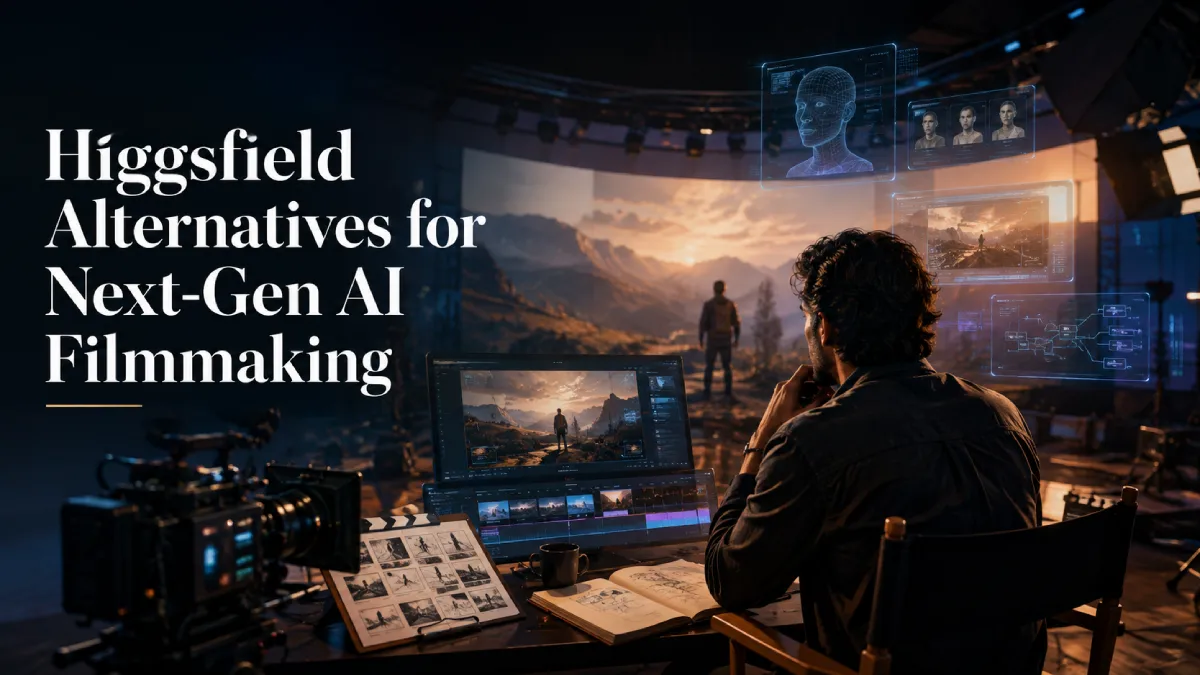
AI filmmaking has moved beyond creating short clips from simple text prompts. Today, creators are looking for tools that can support larger projects, maintain visual direction, and help transform an idea into a complete production workflow. This shift has created demand for platforms that go beyond individual generations and support storytelling, scene planning, character development, and editing.
Higgsfield has gained attention for its focus on cinematic AI video creation, camera movements, and visually rich generations. However, filmmakers often need different capabilities depending on their workflow. Some may prioritize creative control, others may need stronger continuity across scenes, faster production cycles, or a complete environment for building larger projects.
This guide explores some of the leading Higgsfield alternatives for AI filmmaking, comparing how each platform approaches video creation and where each one fits best.
What should you look for in an AI filmmaking tool?
The right AI filmmaking platform depends on the type of project you are creating. A tool designed for short cinematic experiments may not provide everything needed for an episodic series, brand film, or multi-scene production.
Important factors include:
- Visual quality and cinematic control
- Character and scene consistency
- Reference handling
- Camera movement options
- Editing capabilities
- Workflow speed
- Support for different creative stages
Modern AI filmmaking workflows increasingly require more than generating a single impressive shot. Creators need systems that can remember creative decisions and help maintain consistency from the first scene to the final edit.
1. Invideo Agent
Invideo Agent is an AI filmmaking collaborator that helps creators move from an initial idea to a complete video project by supporting writing, planning, generation, and editing workflows. Instead of focusing only on individual clips, it keeps track of project details such as characters, locations, and creative references across different scenes.
This project memory makes it useful for longer-form AI filmmaking workflows where maintaining continuity is important. Creators can define characters, establish visual direction, and build scenes while the agent helps carry those decisions throughout the production process.
Invideo Agent also supports role-based workflows, allowing creators to approach different parts of production with specialised assistance for areas such as planning, cinematography, and casting. This makes it suitable for filmmakers, brands, and teams working on multi-scene projects rather than only one-off generations.
A key area is character consistency. The platform can maintain character references across shots, helping preserve identity details while allowing changes to styling, wardrobe, or environments when needed.
The latest version, invideo Agent Two, expands this workflow with stronger project understanding and expert agents that can work together. It can read materials such as scripts, PDFs, videos, and reference files, helping creators build on existing ideas without repeatedly explaining the same context.
Best for: Filmmakers, studios, brands, and creators producing multi-scene videos, short films, series, and cinematic content.
2. Runway
Runway is one of the most recognised names in generative video creation. It is known for its focus on creative experimentation, visual effects, and AI-assisted video workflows.
The platform provides tools for generating and editing video content, making it popular among creators who want to explore cinematic visuals, stylised sequences, and AI-enhanced footage.
Runway works well for filmmakers who already have a clear production process and need advanced creative tools for individual shots or visual effects. Its strength comes from giving creators control over visual generation and transformation rather than managing an entire production workflow.
For AI filmmaking projects focused on experimental visuals, concept scenes, and creative effects, Runway remains a strong option.
3. Kling AI
Kling AI has become popular for producing realistic motion and detailed video generations. It focuses on creating dynamic scenes with natural movement, making it useful for creators who want visually convincing outputs.
One of Kling’s strengths is motion quality. The platform can generate scenes where movement, camera actions, and subject behaviour feel more natural compared with earlier AI video systems.
Kling can be a good choice for filmmakers who already know the shots they want and need a strong generation engine to bring those ideas to life. It is especially useful for individual scenes, concept visuals, and cinematic experiments where motion quality is the main priority.
However, creators managing larger productions may still need additional tools for planning, continuity management, and editing workflows.
4. Luma AI
Luma AI focuses on realistic video generation and creative visual exploration. Its models are designed to help creators produce cinematic scenes from text and image references.
The platform is often used for generating atmospheric shots, camera movements, and visually detailed sequences. For creators working on mood pieces, advertisements, and early concept development, Luma AI provides a straightforward way to explore ideas visually.
Luma AI works best when the goal is generating individual scenes or creative concepts quickly. Filmmakers creating larger narratives may combine it with other tools to handle planning, consistency, and post-production needs.
5. Pika
Pika is another AI video platform that focuses on making video creation accessible for creators, marketers, and social media teams.
Its workflow is designed around quick generation and creative transformations. Users can create short videos, modify visuals, and experiment with different styles without needing a traditional production setup.
Pika is useful for creators producing social content, visual experiments, and short creative pieces. It may be a better fit for fast content creation rather than complex productions requiring detailed scene management.
How do these Higgsfield alternatives compare?
| Tool | Best suited for | Main strength |
| Invideo Agent | Films, series, brand videos, complex projects | Project memory, production workflow, continuity |
| Runway | Creative visuals and AI-assisted editing | Visual effects and experimentation |
| Kling AI | Cinematic scenes and motion-heavy shots | Realistic movement |
| Luma AI | Concept development and atmospheric visuals | Realistic generation |
| Pika | Short-form creative content | Quick video creation |
How do you choose the right Higgsfield alternative?
The best option depends on your production goals.
If you are creating cinematic experiments or individual shots, tools like Runway, Kling AI, and Luma AI can provide strong creative generation capabilities.
If your focus is fast social content, Pika may offer a simpler workflow.
For creators building larger projects that involve multiple scenes, recurring characters, and ongoing creative decisions, a tool such as invideo Agent with project memory and a complete production workflow can be more suitable.
The future of AI filmmaking is likely to move toward tools that combine generation, planning, and creative collaboration rather than focusing only on single outputs.
Final thoughts
Higgsfield has helped highlight the growing potential of cinematic AI video creation, but creators now have more options depending on their needs. Some tools focus on visual generation, others specialise in motion, editing, or quick content production.
The right choice comes down to the complexity of your project and the level of creative control you need. For filmmakers working on longer narratives, brand films, or multi-scene productions, tools that understand the entire project context can make the creative process more organised and consistent.

Fewer Tabs, Fresher Adverts: What Job Posting APIs Mean for UK Recruitment Teams
Ask any in-house recruiter or agency consultant in the UK where their week goes, and a surprising share of the…
How AI Image Generation Is Changing the Way We Create Visual Content
Creating high-quality images used to require a combination of design skills, expensive software, photography equipment, and plenty of time. Today,…