

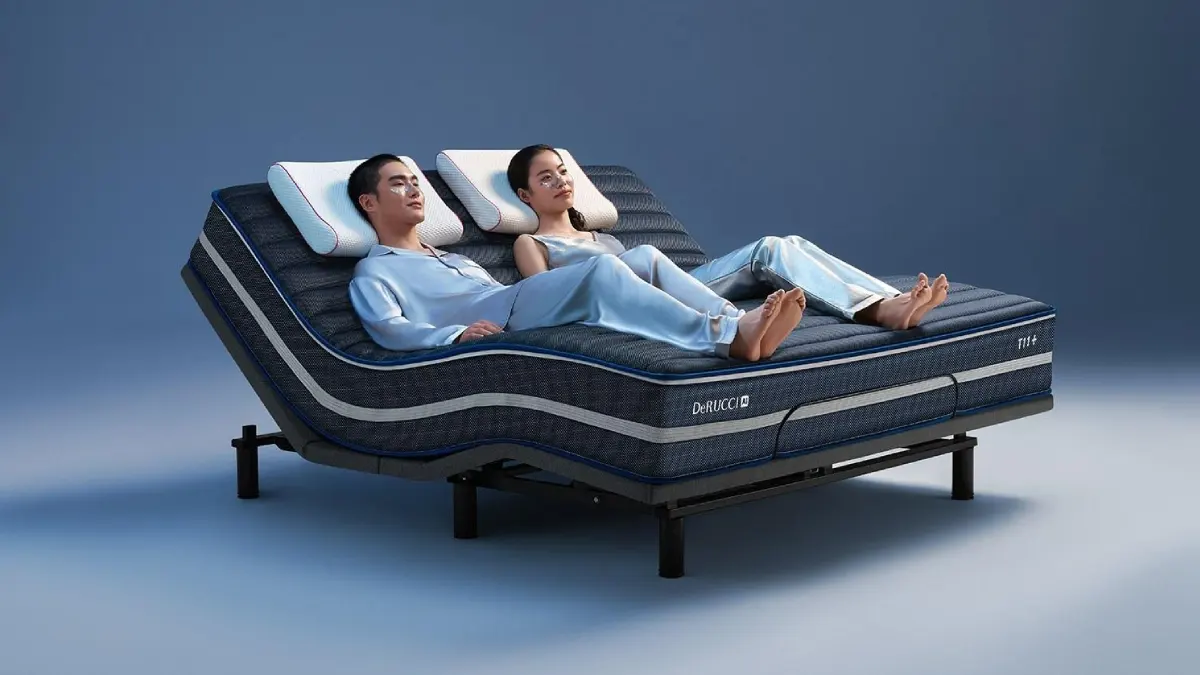
Learn how an AI mattress uses built-in sensors and automatic support to improve sleep comfort, with CAICT data. Explore options today.
By DeRUCCI Team 2026-06-10 10 min read
What Is an AI Mattress? Benefits, Proof, and How to Choose the Right Fit
If a person spends half an hour trying to settle down, turns from side to back more than once, and still wakes with tight shoulders or a tired lower back, the issue is not always sleep discipline. In many homes, the bed has one fixed response while the body keeps changing through the night. An AI mattress, in the way DeRUCCI presents the category, is built to read pressure, adjust support, and respond during sleep instead of waiting until discomfort has already interrupted rest.
Executive Summary
An AI mattress is a sleep system with built-in sensors, automatic firmness adjustment, and responsive support that helps the bed adapt to the sleeper overnight. It differs from a regular mattress because its support can change automatically, and it differs from a standard adjustable bed because it does not depend mainly on manual remote control.
A simple way to explain an AI mattress is to compare it with a smart thermostat. A basic thermostat needs someone to get up and change the setting. A smart thermostat monitors the room and adjusts temperature in the background. A regular mattress works in a similar fixed way: the sleeper has to adapt to the surface. An AI mattress tries to make the surface adapt to the sleeper as pressure and posture change.
That distinction matters because sleep is not a static state. Shoulders, hips, back, and legs load the mattress differently when someone moves from side sleeping to back sleeping, shifts weight, or stays in one position for several hours. The point at which support needs to change is often the point at which the sleeper is no longer awake enough to make a useful adjustment.
For shoppers asking what an AI mattress is and whether it actually works, the answer should come from product design and evidence rather than broad smart-home language. Three checks are especially useful: whether the mattress senses the body without requiring a wearable, whether it adjusts support automatically, and whether claimed sleep outcomes are backed by independent testing.
Core Insights
The value of an AI mattress is not movement for movement’s sake. The practical value is support that changes at the right time with less effort from the sleeper. Stronger products in this category combine body-pressure reading, quiet firmness adjustment, independent support on each side, and sleep data that can be checked through credible third-party testing.
Key points for consumers:
- An AI mattress is not simply a bed with a remote control.
- Built-in sensors can read how the body presses into the mattress without requiring a wearable device.
- Air-pressure zones that adjust firmness automatically can respond to different body areas.
- Couples may benefit when each side independently adapts to different sleep needs.
- Independent CAICT lab testing on DeRUCCI T11+ reported sleep onset time 37.3% shorter, meaning a person who usually takes 30 minutes to fall asleep may take about 19 minutes.
- The T11 series is currently available in Australia, Singapore, Malaysia, and Vietnam.
- North America shoppers should check regional availability because the US and Canada currently focus on traditional DeRUCCI mattresses such as Taputa Latex Mattress and Century Dream 3D Latex Mattress. DeRUCCI’s AI mattress lineup is expected to become available in North America in the second half of 2026.
What Is an AI Mattress, Really?
An AI mattress is a responsive sleep system that senses how the body rests on the bed and automatically adjusts support. The defining feature is not a remote, a motor, or an app by itself. The defining feature is that the mattress can read changing comfort needs and respond while the person is asleep.
A clear definition is useful because many products now carry smart features, but not all of them solve the same sleep problem. An AI mattress brings together three functions: built-in sensors, automatic firmness adjustment, and support that can change through the night. The purpose is to reduce the gap between what the body needs at a given moment and what a fixed mattress can provide.
A regular mattress is passive. It has a comfort feel, support layers, and a fixed firmness profile. If that feel happens to match the sleeper well, the mattress can be a good choice. If it does not, the sleeper has to compensate by changing position, adding pillows, adjusting sleep posture, or accepting pressure around the shoulders, hips, or lower back.
An ordinary adjustable bed adds movement, but much of that movement still depends on the user. The sleeper presses a remote, raises the head or feet, or chooses a preset position. That can be helpful before sleep, while reading, or while relaxing. Once the person falls asleep, however, manual control becomes less relevant. The body continues to shift, while the user is no longer actively managing the bed.
An AI mattress is designed to address that timing problem. Similar to air conditioning that adjusts room temperature without asking someone to wake up and turn a dial, the mattress handles support changes quietly in the background. The practical idea is straightforward: a regular bed asks the person to adapt to it; an AI bed helps the bed adapt to the person.
That is why the search term AI mattress has become more relevant. Many consumers are not looking for a futuristic gadget. They are trying to solve familiar sleep issues: taking too long to fall asleep, waking up sore, disturbing a partner, or feeling that one fixed firmness never works for the whole night.
Why Does Sleep Support Need AI?
Sleep support needs AI because the body does not remain in one position. Pressure moves across the shoulders, hips, back, and legs during the night. The best time for support to adjust is often after the sleeper has already drifted off, which makes manual control an incomplete solution.
The nighttime problem is practical rather than theoretical. People can choose a preferred firmness while they are awake, but sleep itself is dynamic. A side sleeper may need more pressure relief around the shoulder. A back sleeper may need steadier support under the lower back. A person who changes position may need both conditions during the same night.
Think about a car seat on a long drive. The seat may feel acceptable at the start, but after two hours, pressure points become easier to notice. A driver can shift posture or adjust the seat. A sleeping person has far less active control. The result can be repeated turning, brief awakenings, or soreness that becomes noticeable in the morning.
Partner disturbance adds another practical factor. One person’s movement can travel across the mattress and interrupt the other person’s rest. For that reason, sleep support is not only an individual comfort issue. For couples, one person’s repeated turning can become a shared sleep problem.
This change is often described as Sleep 3.0: moving from people adapting to beds toward beds that actively adapt to people. Traditional sleep products were built around average body types and fixed comfort layers. AI sleep systems are built around changing pressure patterns and individual support needs.
The global sleep technology market is also projected to grow from $25.26 billion in 2025 to $57.47 billion in 2030, with a 17.2% CAGR. In plain terms, more consumers are looking beyond basic pillows, supplements, and fixed mattresses when they try to improve sleep.
AI Mattress vs Regular Mattress vs Adjustable Bed
Not every bed that moves is truly smart. A regular mattress offers fixed support. An ordinary adjustable bed offers manual movement. An AI smart bed adds automatic sensing and support adjustment, so the shopping question changes from whether the bed can move to whether it can respond while the sleeper is asleep.
The differences become clearer in a simple comparison:
| Feature | Traditional Spring Mattress | Ordinary Electric Bed | AI Smart Bed |
| Support style | Fixed comfort and support | Preset positions | Automatic support adjustment |
| Sensing ability | No sensing | Usually no real-time body sensing | Built-in sensors read pressure patterns |
| User effort | No controls | Remote or app control needed | Adjusts in the background |
| Response during sleep | Does not change | Limited unless user wakes and adjusts | Can respond quietly through the night |
| Couple comfort | Shared surface can transfer movement | Movement may disturb partner | Each side independently supported in stronger systems |
| Evidence to ask for | Materials and durability | Motor and frame quality | Independent sleep testing plus product design |
A traditional mattress can still be the right fit for shoppers who want simplicity, durability, and a familiar feel. Its limitation is that it cannot sense whether the sleeper’s shoulder is under pressure or whether the lower back needs more lift at a particular point in the night.
An ordinary adjustable bed can be useful for reading, relaxing, or raising the upper body and legs. Its limitation is that it often depends on manual control. If a sleeper needs more support at 2:00 a.m., the bed may not help unless the person wakes up and uses the remote.
An AI smart bed is different because it is designed around automatic response. In DeRUCCI’s approach, the T11 series focuses on support adjustment without asking users to manage comfort only after they have already woken up uncomfortable. The point is not to add more buttons. The point is to reduce the amount of work the sleeper has to do.
How Does an AI Mattress Work While You Sleep?
An AI mattress works through a sequence: built-in sensors read pressure, the system identifies movement and support needs, air-pressure zones that adjust firmness automatically respond across the body, and each side can adapt separately for couples. The process is designed to happen quietly while sleep continues.
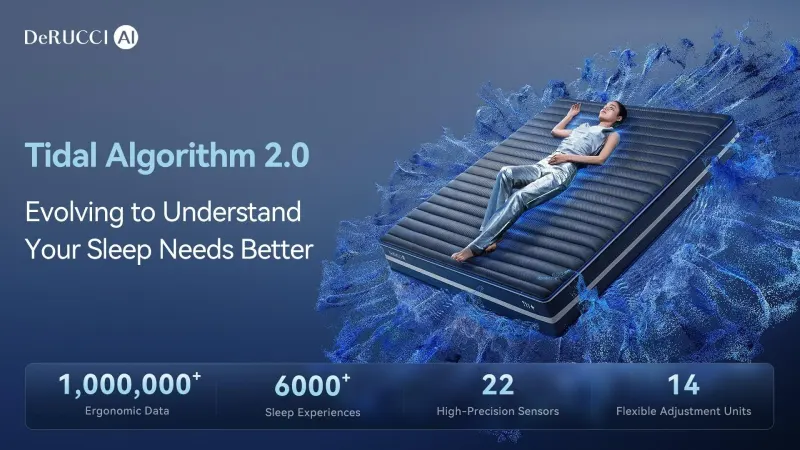
Step 1: built-in sensors read how the body presses into the mattress. No wearable device is required for the mattress to understand pressure patterns. This matters for people who dislike wristbands, rings, or devices that need charging before bed.
Step 2: the system identifies where pressure is building. For example, a side sleeper’s shoulder and hip may press more deeply into the bed. A back sleeper may need steadier support under the lower back. The mattress reads the difference between these pressure patterns.
Step 3: air-pressure zones that adjust firmness automatically respond across different body areas. A useful way to think about this is a fit process that treats each area of the body differently rather than applying one uniform setting everywhere. The goal is not to make every zone feel identical. The goal is to support different parts of the body appropriately.
Step 4: each side independently adapts for couples. If one sleeper turns frequently while the other remains still, independent support can help reduce shared disturbance. This does not mean movement disappears, but it can make the night feel more stable for both people.
Step 5: support keeps changing through the night. This is the major difference from preset comfort. Presets are chosen before sleep. AI support can keep working after the sleeper has stopped making decisions.
DeRUCCI also emphasizes fast response in its AI smart mattress positioning, including 20ms automatic sensing and left-right independent zone support in its category communications. For a consumer, the practical meaning is direct: the system is designed to react quickly enough that support changes feel like part of the sleep environment rather than a separate mechanical action.
Does an AI Mattress Actually Improve Sleep?
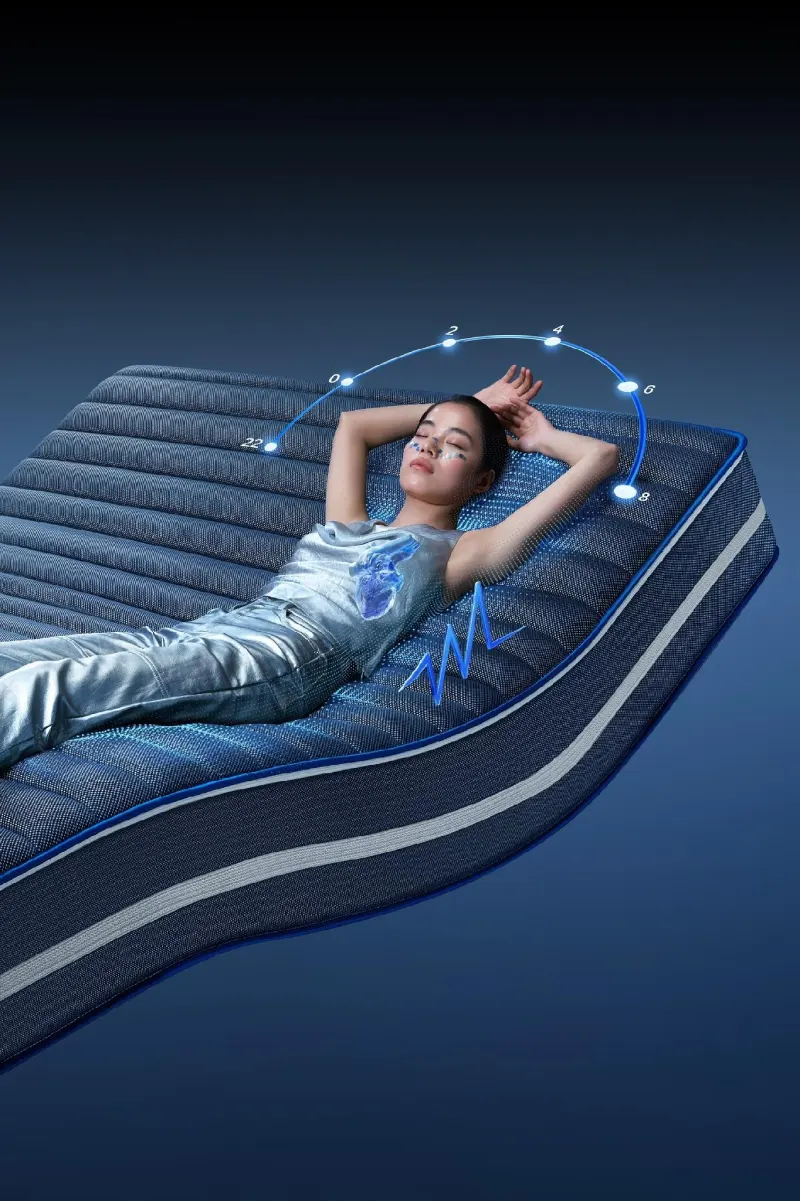
The strongest answer comes from independent testing rather than comfort claims alone. According to independent CAICT lab testing on DeRUCCI T11+, measured outcomes included shorter sleep onset time, fewer nighttime turnovers, longer deep sleep duration, and longer continuous deep sleep. Each metric points to a practical sleep benefit.
According to independent CAICT lab testing, DeRUCCI T11+ showed that sleep onset time, meaning time to fall asleep, was 37.3% shorter. In everyday terms, someone who usually takes 30 minutes to fall asleep may fall asleep in about 19 minutes. That is roughly 11 minutes saved at the start of the night.
The same CAICT testing reported that nighttime turnovers dropped 27.5%. In human terms, that means tossing and turning almost 30% less. For a couple, fewer turns may also mean a quieter night for the partner.
CAICT testing also reported that deep sleep duration increased 4.5%. That means more time in deep, restorative sleep, which can improve the chance of waking up feeling refreshed rather than simply spending more hours in bed.
Continuous deep sleep increased 5.9% in the CAICT testing for T11+. Put simply, deep sleep lasted longer with fewer interruptions. Less fragmented deep rest can feel more restoring because the body is not repeatedly pulled out of its most restful phase.
These results should be interpreted with care. The data is from T11+, not a universal claim for every AI mattress on the market. It also does not mean every person will experience the same result in every home. What it does provide is a stronger trust anchor than general claims such as better comfort or smarter sleep. For consumers, independent data is a practical filter.
What Should You Check Before Buying an AI Mattress?
Before buying an AI mattress, shoppers should verify automatic adjustment, built-in sensors, independent support for couples, quiet operation, comfort quality, and third-party test data. The best purchase decision comes from matching the technology to real sleep problems rather than buying from a feature list.
Start with automatic adjustment. If a bed requires manual remote control for every meaningful change, it may be closer to an ordinary adjustable bed than a true AI mattress. Ask whether the system responds during sleep, not just before sleep.
Next, check whether the mattress uses built-in sensors without requiring a wearable device. Wearables can be helpful, but many people stop using them because they need charging, feel uncomfortable, or add one more step to the bedtime routine.
Couples should ask whether both sides can adjust independently. Different body weights, sleep positions, and firmness preferences can make one shared setting feel like a compromise. Independent support is especially important when one partner moves more often.
Ask for independent test data. Comfort language can sound persuasive, but data makes claims easier to evaluate. Look for specific metrics such as sleep onset time, nighttime turnovers, deep sleep duration, and continuous deep sleep.
Also consider quiet operation, firmness range, comfort layers, edge support, app simplicity, and after-sales service. A mattress can be technically advanced and still disappoint if it feels noisy, complicated, or uncomfortable on the surface.
Before You Buy: Availability Check
- T11 series is currently available in Australia, Singapore, Malaysia, and Vietnam.
- North America, including the US and Canada, currently offers traditional DeRUCCI mattresses such as Taputa Latex Mattress and Century Dream 3D Latex Mattress, plus bed frames including Galaxy, Madrid, and Leisurely.
How DeRUCCI Approaches AI Sleep Support
DeRUCCI’s AI sleep approach is built around research, collaboration, and verification. Its positioning combines 12 consecutive years of sleep whitepaper work, MIT cooperation, the Harvard CPC connection for the T11 PRO SleepCare System, and CAICT testing data for T11+ as a measurable trust signal.
DeRUCCI does not need to begin the discussion with a product claim. The stronger starting point is the sleep problem itself: fixed support cannot always match a changing body. From that point, the brand’s AI mattress work is positioned as a response to a practical nightly gap.
The company’s research-first approach includes 12 consecutive years of sleep whitepaper work, signaling that its sleep-health positioning is not built only around a short-term trend. The brand also highlights scientific collaboration signals, including MIT cooperation and the Harvard CPC connection for the T11 PRO SleepCare System.
Product logic matters as much as research. DeRUCCI’s AutoFit-style automatic support focuses on reducing the need for users to wake up, notice discomfort, and manually adjust the bed. This is the practical difference between a bed that looks smart and a sleep system that responds in the background.
Independent verification adds another layer. CAICT testing data for T11+ gives consumers specific numbers to evaluate: 37.3% shorter sleep onset time, 27.5% fewer nighttime turnovers, 4.5% longer deep sleep duration, and 5.9% longer continuous deep sleep. These figures help translate AI sleep support from a product concept into measurable outcomes.
For readers in eligible markets who want to understand the technology before shopping, DeRUCCI provides more detail on its AI mattress sleep support technology.
Who Is an AI Mattress Best For?
An AI mattress is best suited for people who want adaptive support without constant manual adjustment. It may be especially useful for sleepers who wake up sore, couples with different comfort needs, and consumers who want sleep improvement without wearing a tracker.
People who wake up with shoulder, hip, or lower-back soreness may benefit from support that changes across body areas. A fixed mattress can feel good at bedtime but become less helpful after several hours in one position.
Couples may also be strong candidates. If one person prefers a softer feel and the other needs firmer support, a shared fixed mattress can create compromise. If one person tosses and turns, the other may lose sleep. Independent support on each side can help address both issues.
People who dislike wearables may also prefer an AI mattress with built-in sensors. Sleep tracking is less helpful if the device sits uncharged on a nightstand. Built-in sensing reduces that daily friction.
AI mattresses are also suitable for shoppers comparing smart sleep technology with traditional mattresses and ordinary adjustable beds. The key is to focus on the problem: does the sleeper need automatic support at night, or would a simple fixed mattress be enough?
Some shoppers may not need an AI mattress. A person who wants a basic mattress, has stable comfort needs, and does not want automatic features may be better served by a traditional model. The right choice is not the most advanced product; it is the product that matches the sleeper’s real needs.
FAQ: Common Questions About AI Mattresses
AI mattress questions usually come from practical concerns: whether the technology is real, whether it helps sleep, whether wearables are required, and whether couples benefit. The clearest answers focus on sensing, automatic support, independent adjustment, and verified sleep data rather than vague smart-home language.
What is the difference between an AI mattress and a smart mattress?
An AI mattress is a type of smart mattress focused on automatic support adjustment. Some smart mattresses may track data, connect to an app, or offer remote-controlled features. An AI mattress should go further by using built-in sensors to read pressure and adjust firmness automatically while the sleeper rests.
Can an AI mattress help me fall asleep faster?
It may help if pressure discomfort or poor support is part of the reason a person struggles to fall asleep. According to independent CAICT lab testing on DeRUCCI T11+, sleep onset time was 37.3% shorter. For someone who usually needs 30 minutes, that may mean falling asleep in about 19 minutes.
Do I need to wear a device for an AI mattress to work?
A well-designed AI mattress should use built-in sensors, so a wearable device is not required for basic pressure reading and support adjustment. This is useful for people who do not want to sleep with a wristband, ring, or device that needs nightly charging.
Is an AI mattress useful for couples?
Yes, an AI mattress can be useful for couples when each side independently adjusts. This helps address different firmness needs and can reduce disturbance from tossing and turning. CAICT testing on DeRUCCI T11+ reported nighttime turnovers dropped 27.5%, meaning nearly 30% less movement during the night.
Is an AI mattress worth it compared with a normal adjustable bed?
An AI mattress may be worth it for shoppers who want automatic support during sleep rather than manual position changes before sleep. A normal adjustable bed can raise the head or legs, but an AI mattress focuses on sensing pressure and adjusting comfort while the person is asleep.
LocatorShop Reference
The best way to evaluate an AI mattress is to connect the concept with body feel. Reading data explains the technology, but lying down helps a shopper notice pressure relief, firmness changes, quiet operation, and whether independent support feels useful for a real sleep routine.
AI mattress technology is easiest to understand when it is tested against a real body, not just read on a screen. Shoppers can compare support feel, ask about regional model availability, and confirm whether the T11 series or traditional DeRUCCI mattresses are offered in their market.
For in-store experience, model availability, and detailed addresses, visit the global store locator and address guide.


Third-Party vs Comprehensive Insurance: Finding the Right Cover for Your Scooter
Your scooter needs reliable insurance that can provide financial protection when any unexpected situation arises. Third-party and comprehensive policies provide…

How to Compare Health Insurance Claim Settlement Ratios?
A health insurance claim settlement ratio can appear to offer a quick answer about an insurer’s reliability, but one percentage…